
Honest. Updated 2026. No affiliate links.
China has one of the best transportation networks in the world. The metro is fast and cheap. The high-speed trains are genuinely jaw-dropping. Getting around is easier than most people expect — once you know which apps to use and which ones to skip.
Here's the headline: two apps and you're done. Alipay handles everything (metro, taxi, trains, flights). Amap handles maps. That's the entire stack. Don't let anyone talk you into installing five more.
This guide covers everything: maps, taxis, metro, high-speed rail, the Shanghai Maglev, and domestic flights. In that order, because that's the order you'll actually need them.
First: Download Amap. Everything else builds on it.
Before you set up anything else, download Amap (高德地图). It's China's most accurate map app, and it works completely in English.
Google Maps technically works in China, but the data is unreliable — street names are off, routes don't account for local traffic patterns, and transit directions are often wrong. I've watched people get completely turned around in Shanghai because they were following Google Maps instead of Amap. Don't be those people.
What Amap does well:
- Walking, driving, transit, and cycling routes — all accurate
- Search in English and get results in the right location
- Real-time traffic for taxis and DiDi
- City metro maps with live route planning
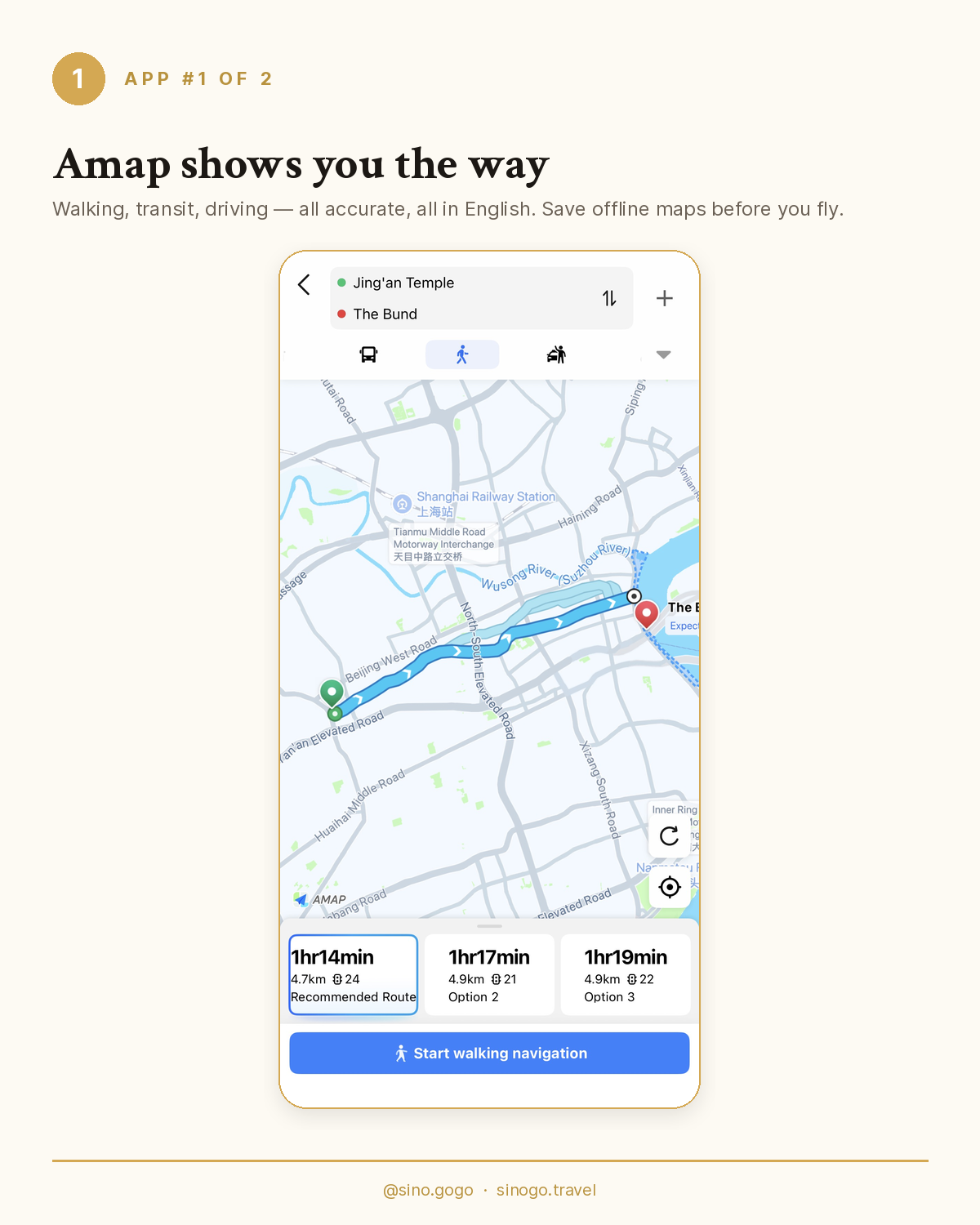
One thing to do before you fly: download offline maps for the cities you're visiting. Signal inside metro stations can be weak, and having offline maps means you're never stuck.
🐷 Bao's tip: Amap's transit directions show you exactly which exit to take from each metro station. This sounds small but saves you a lot of "which way is north" confusion when you surface from underground.
Metro — the fastest and cheapest way to move around cities
Every major Chinese city has a metro system that's clean, fast, air-conditioned, and extremely well-signposted in English. It's almost always the right choice for getting across a city.
How to pay — 3 options
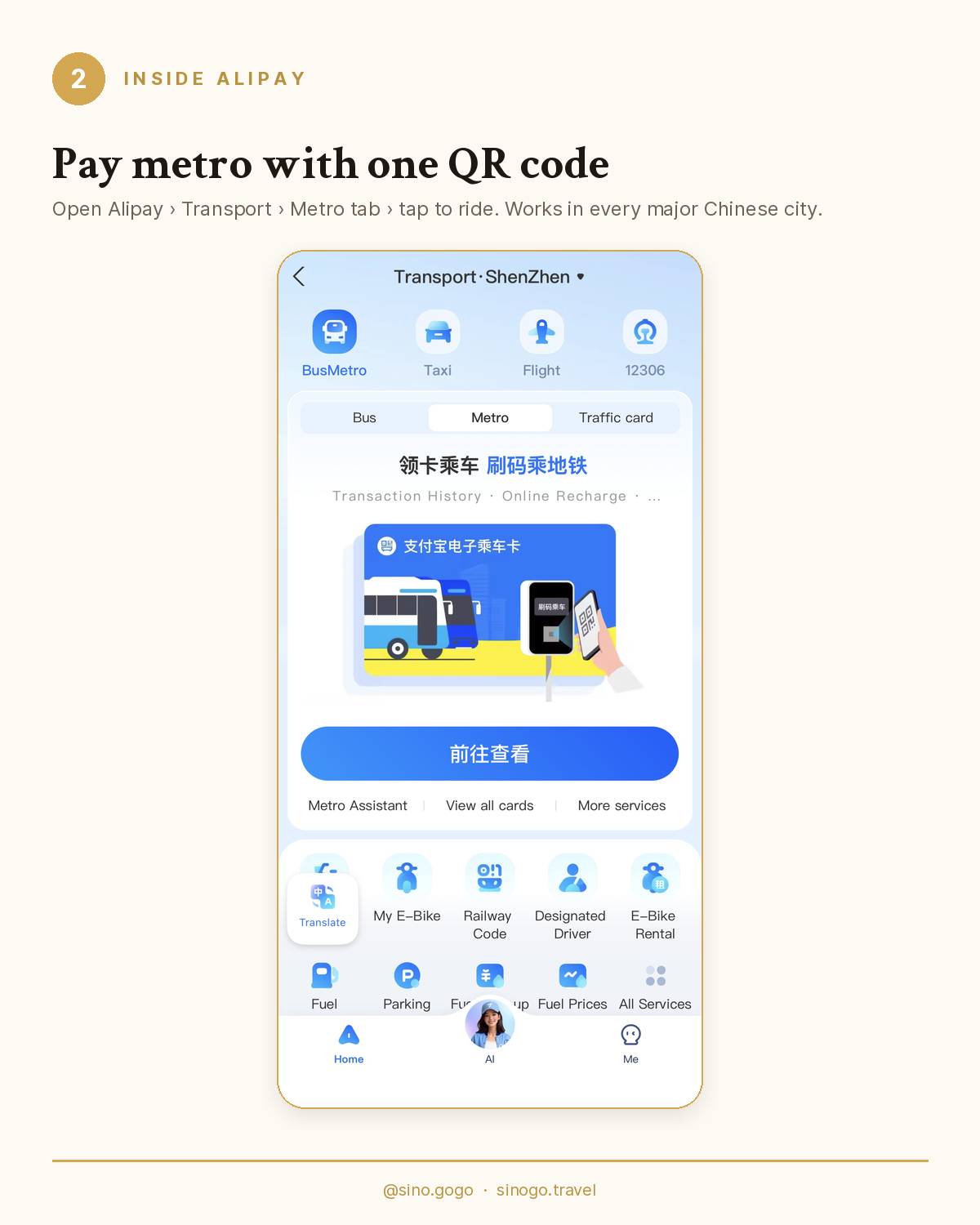
Option 1: Alipay QR code (easiest) Open Alipay → tap "Transport" on the home screen → enable the QR code → scan at the gate. Done. No transit card needed, no cash, no app to download. This works in Beijing, Shanghai, Guangzhou, Shenzhen, Chengdu, and most major cities. If you've already set up Alipay (which you have, because you read Article 1), this takes about 20 seconds to set up.
Option 2: City metro apps Each city has its own official metro app. Shanghai uses DaDuHui (大都会), Beijing uses Yitongxing (亿通行). They work fine, but they're one more app to download and register for. Unless you're spending a lot of time in one city, Alipay's transport function does the same thing with less effort.
Option 3: Physical transit card Available at the service desk in any metro station. Pay a ¥20 deposit, top up with cash, tap to enter and exit. Old-school, works everywhere, no phone needed. Good backup option if your phone dies.
🐷 Bao's tip: Avoid rush hour — 8–9 AM and 5–7 PM. Chinese rush hour is not a metaphor. Shanghai Line 2 during peak hours is an experience in human compression that no one needs on their vacation.
Taxis and DiDi — via Alipay, not a separate app
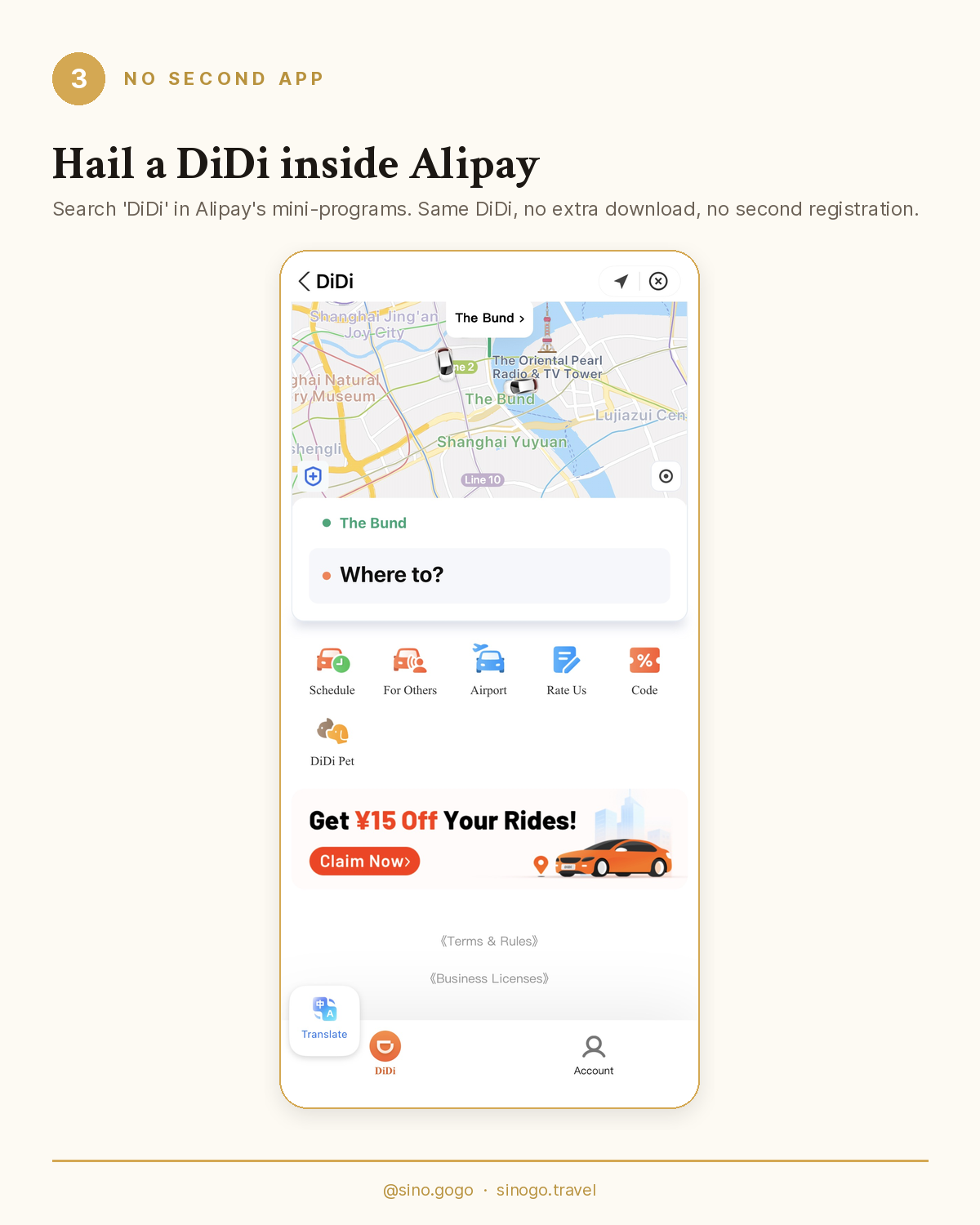
Here's what most guides get wrong: they tell you to download DiDi as a standalone app. You don't need to. If you have Alipay set up, you can call a DiDi directly through Alipay's mini-program — no separate download, no second registration.
Open Alipay → search "DiDi" in the mini-programs search bar → the DiDi interface opens inside Alipay → type your destination in English → book your ride.
It works exactly the same as the DiDi app, uses the same payment you've already set up, and doesn't require you to install another application or create another account.
If you prefer street taxis
Street taxis still exist and are metered — they're not going anywhere. The challenge is communication. Most taxi drivers speak minimal English, which isn't a problem if you're prepared.
The move: screenshot your destination's name and address in Chinese characters before you go. Show the driver the screen. That's the whole interaction. Amap can help — search for your destination, tap on it, and it shows the Chinese name you can screenshot.
🐷 Bao's tip: If a driver calls you after accepting your DiDi, don't panic. They're usually asking for more specific pickup directions. Drop a location pin in the app chat — it auto-translates and most drivers understand it immediately.
High-Speed Rail — the best thing in Chinese transportation
Here's something Western visitors consistently underestimate: China's high-speed rail is extraordinary.
We're talking about trains that run at 300–350 km/h, depart almost perfectly on time, stop at massive modern stations, and connect cities in a fraction of the time a flight would take when you factor in airport check-in. Beijing to Shanghai: 4.5 hours. Shanghai to Hangzhou: 45 minutes. Guangzhou to Shenzhen: 30 minutes. These are distances that would take half a day by car.
The seats are wide. The ride is smooth enough to balance a cup of coffee on the fold-out tray without spilling it. The trains are quiet. There's power at every seat. The scenery — rice paddies, mountains, river deltas — slides past at a speed that makes you feel like you're watching a time-lapse.
I'm not exaggerating when I say that first-time visitors often list the high-speed train as one of the highlights of their China trip. It's worth booking at least one journey just for the experience.
How to book — inside Alipay, no extra app needed
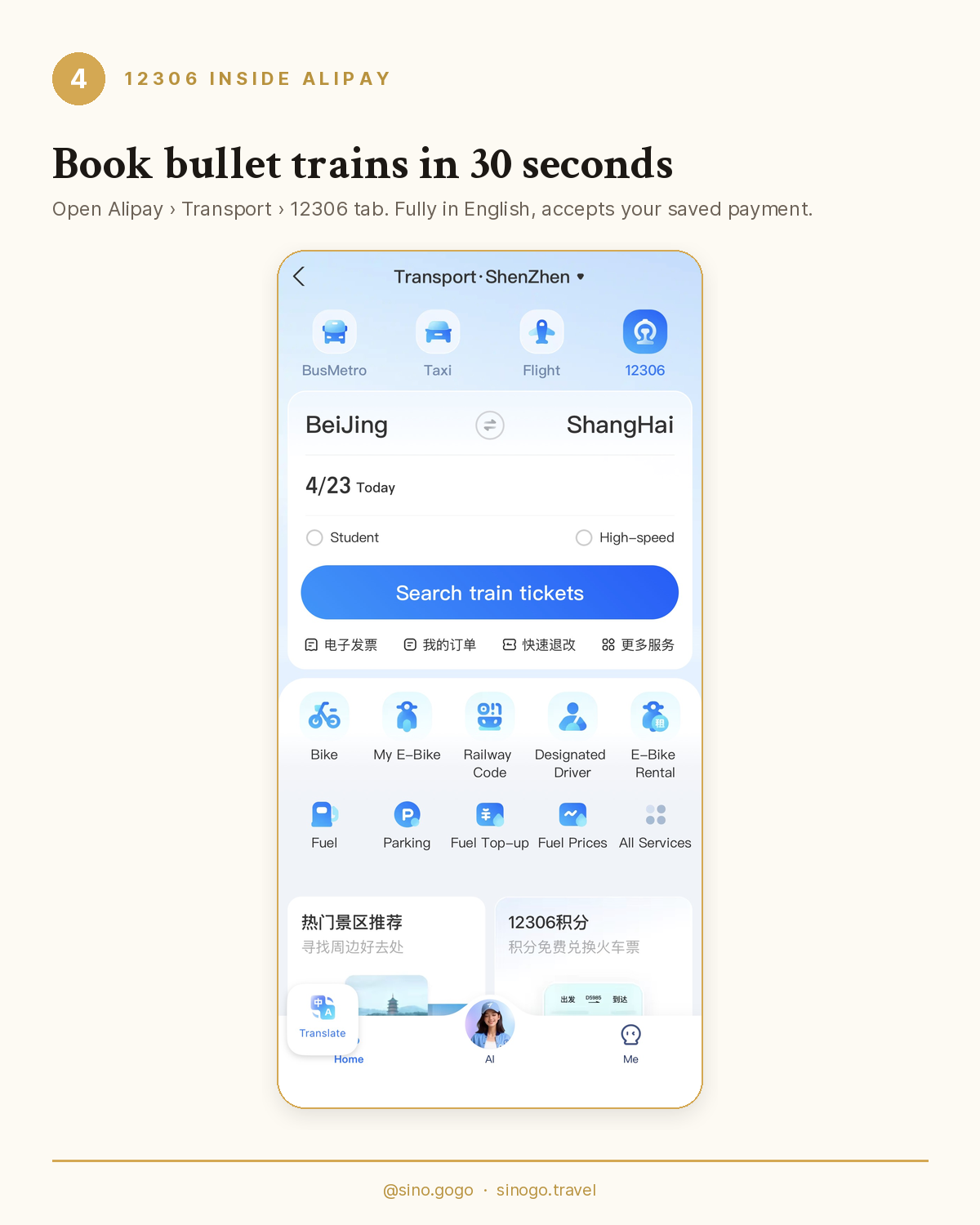
This is where most guides will tell you to download Trip.com or 12306. You don't need either. Alipay has 12306 built in — fully in English, accepts the payment method you've already set up, and gives you e-tickets in seconds.
Open Alipay → Transport → tap the 12306 tab → enter your route → search → pay. You'll need your passport number — China's train system ties every ticket to an ID document, and Alipay will save it once so you don't re-enter it.
That's it. No second app. No second registration. No third payment method.
If you really prefer using the standalone Trip.com website on a laptop (some people like the bigger screen for trip planning), it works fine and accepts international cards too. But on your phone, the Alipay route is genuinely the path of least resistance.
At the station
Chinese train stations are large — arrive at least 30 minutes early. Look for the "Foreign Passport" lane at the ticket collection counter; show your passport and they print your ticket. Security is similar to an airport. Platforms are well-signposted in English.
Your seat is assigned, so there's no rush to board early. Seats are numbered by carriage and seat number, printed on your ticket.
🐷 Bao's tip: Book second class (二等座) unless you specifically want to splurge. It's clean, comfortable, and significantly cheaper than first class. The difference in experience is not proportional to the price difference. First class is a wider seat. That's it.
Shanghai Maglev — 430 km/h, worth doing once
If you're flying into Shanghai Pudong airport, you have a decision to make: take the metro into the city (about 1 hour, very cheap), or take the Maglev.
The Maglev is the world's fastest commercial train in regular operation. It runs between Pudong airport and Longyang Road station in 8 minutes flat, hitting a top speed of 430 km/h. You feel the acceleration press you into your seat, then glance at the speed display showing 431 km/h, and then you're there.
It doesn't connect directly to central Shanghai — you transfer to the metro at Longyang Road — so the total journey time ends up being similar to taking the metro the whole way. It's not the practical choice. It's the fun choice.
The details:
- Cost: ¥50 single, ¥80 return (versus ~¥8 on the metro)
- Run time: 8 minutes airport to Longyang Road
- Frequency: every 15–20 minutes
- Hours: approximately 6:45 AM – 9:40 PM
If you have luggage and you're tired, take the metro. If you've just landed and you want to start your China trip with something genuinely memorable, take the Maglev.
🐷 Bao's tip: Sit on the right side of the train (when facing the direction of travel toward the city) if you want to see the other Maglev train pass going the opposite direction at 860 km/h of combined speed. It happens in a fraction of a second. You'll miss it if you blink.
Domestic Flights — faster than you think to book
For longer distances — say, Shanghai to Chengdu, or Beijing to Kunming — domestic flights make more sense than trains. China's domestic aviation network is enormous, fares are often surprisingly cheap, and the airports (especially newer ones) are genuinely impressive pieces of infrastructure.
How to book — inside Alipay, no extra app needed
You don't need a separate app for this either. Alipay has two ways to book flights, both inside the app:
Path 1 (recommended): TripAir-Train Open Alipay → search TripAir-Train in the mini-programs search → enter your cities and date → search → pay. Clean interface, English throughout.
Path 2: Transport → Flight Open Alipay → Transport → tap the Flight tab → enter cities and date → search → pay. Same result, slightly different interface.
Prices are basically the same on both — pick whichever feels more natural. TripAir-Train tends to be the cleaner experience for flights specifically.
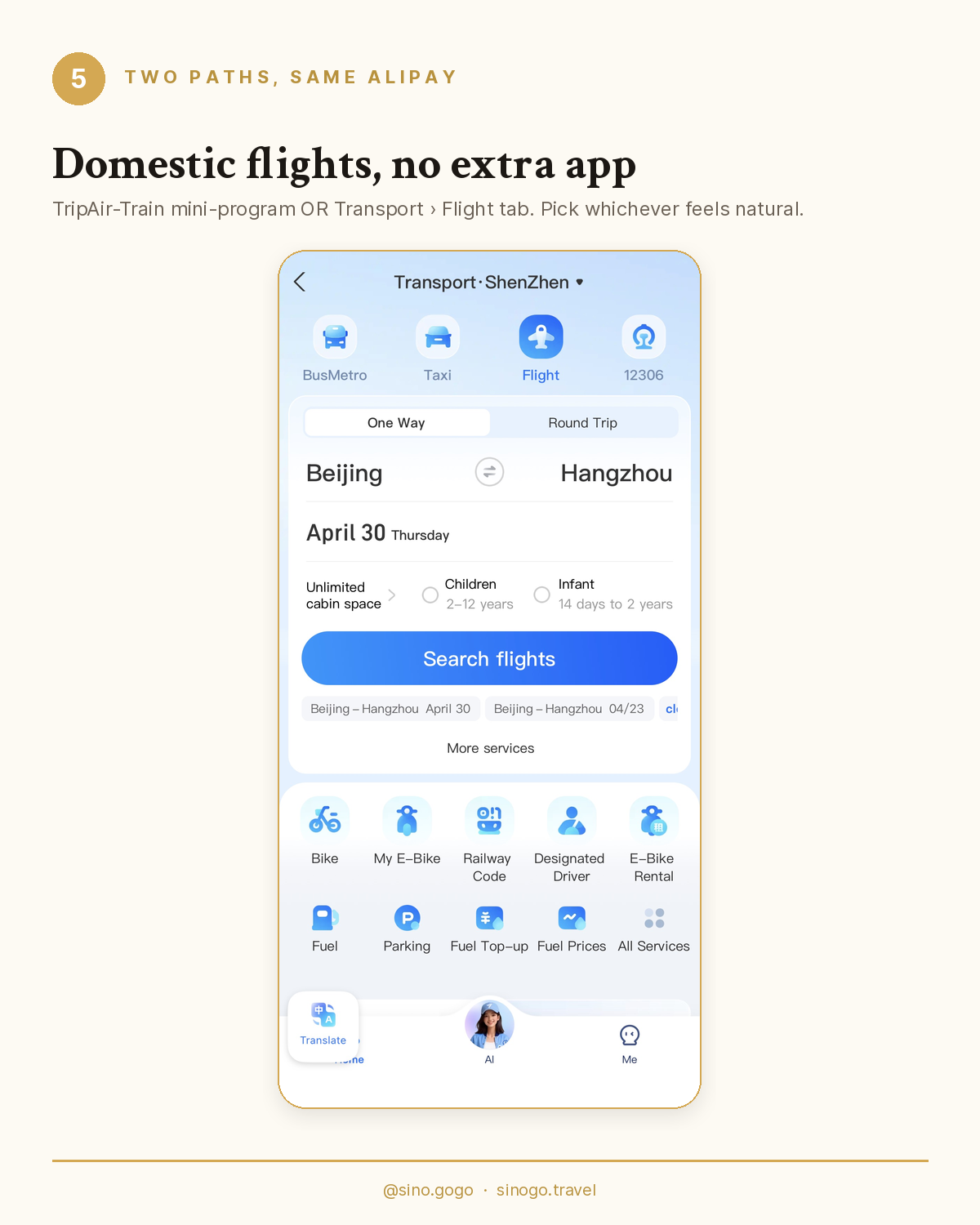
What you need: Your passport details (name exactly as it appears in your passport). Alipay remembers it from your first booking, so you usually don't re-enter it.
If you'd rather book direct: Air China, China Eastern, and China Southern all have English-language websites where you can book through the airline. The experience is a bit clunkier and you have to enter card details again, but it works fine if you specifically want to fly with one carrier.
At the airport
Chinese airports require you to check in at least 45 minutes before domestic departure, though an hour is safer. ID checks at domestic airports use your passport — have it accessible, not buried in your bag.
Security follows international standards. Liquids under 100ml, electronics out of bags.
Most major airports have English signage throughout. If you're confused, airport staff in major hubs usually have basic English or will find someone who does.
🐷 Bao's tip: Check luggage allowances before you pack. Domestic economy fares in China often include only 20kg checked baggage, and some budget carriers (like 9 Air or Ruili Airlines) charge extra for luggage the way Ryanair does in Europe. Look at the fare details before you assume it's included.
Your China Transport Checklist
Before your trip:
- Download Amap and save offline maps for your cities
- Set up Alipay (Article 1) — this powers metro, DiDi, trains, AND flights
- Screenshot your hotel address in Chinese characters — show taxi drivers
- That's it. Two apps. Don't install anything else yet.
Once you're there:
- Metro is almost always the right call for getting across cities
- Use Alipay's transport function for DiDi — no separate app needed
- Use Alipay → Transport → 12306 for trains, TripAir-Train (or Transport → Flight) for flights — no separate apps needed
- Buy a transit card at the station if you prefer cash over QR codes
- If you land at Shanghai Pudong and have energy, take the Maglev at least once
The honest version
Chinese transport gets a reputation for being complicated. It's not — it's just different from what most Western visitors are used to. Once Alipay and Amap are set up, the rest of the system slots into place. The metro is reliable. The trains are genuinely excellent. And the Maglev is the kind of thing you'll still be talking about a year later.
Get the apps. Book the train. Take the Maglev.
Updated April 2026. Train schedules and fares change seasonally — check 12306 inside Alipay for current times. For everything else you need before arriving in China, start here.