
Honest 2026 money guide. Updated with receipts. No affiliate links.
Most travel guides still tell you to bring lots of US dollars to exchange in China.
They were right in 2018. They're wrong in 2026.
Here's what you actually need:
The whole stack (read this only)
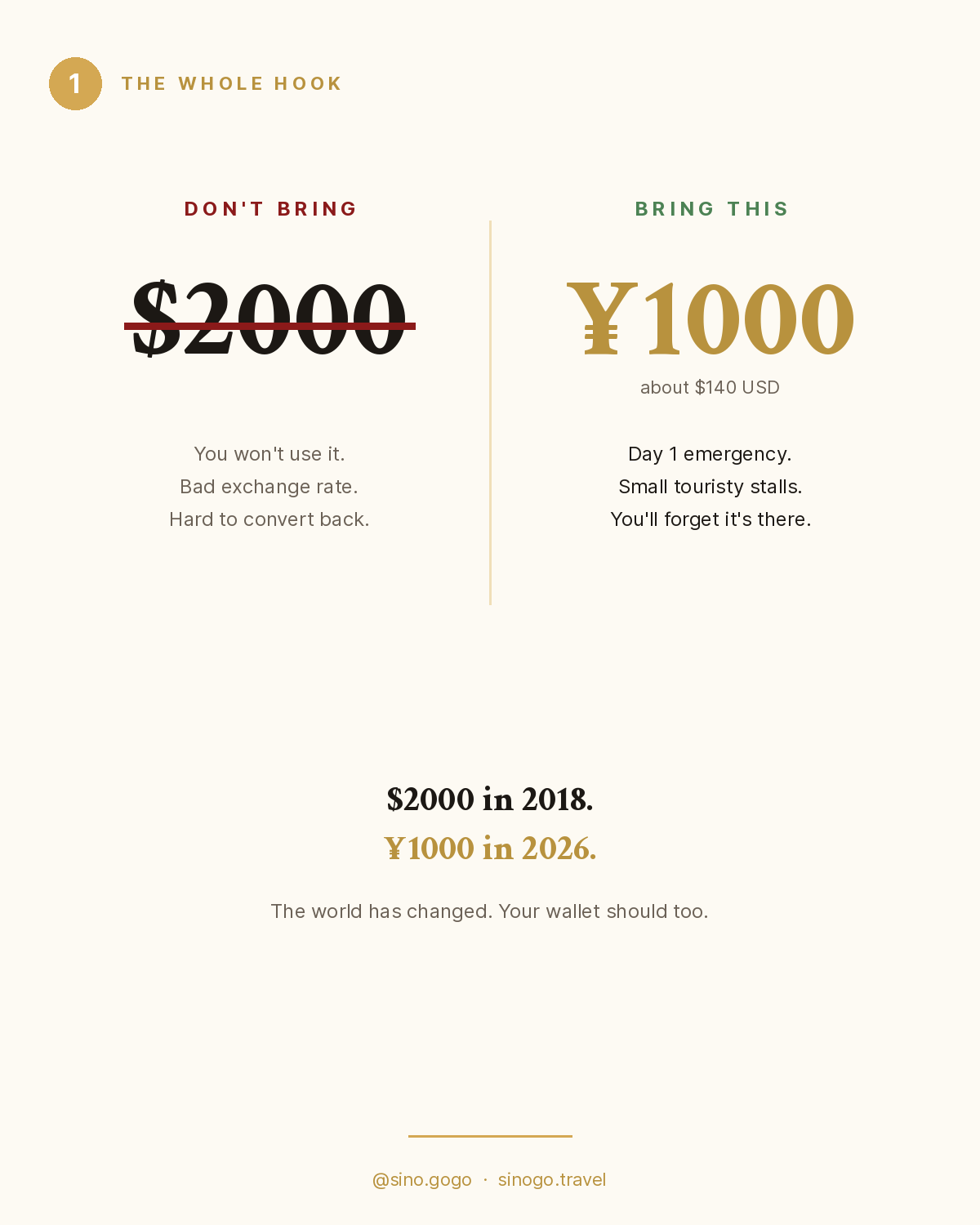
| Item | Bring? | Why |
|---|---|---|
| Alipay + foreign card | ✅ Set up before you fly | Powers 99% of payments |
| WeChat Pay + foreign card | ✅ Set up too | Some restaurants only do WeChat-based mini-program ordering |
| ¥1000 cash (~$140) | ✅ Bring this much | For your first day + small touristy places |
| 2 credit cards (Visa/Mastercard) | ✅ Bring two | Main + backup. One stays in hotel safe. |
| $2000 USD | ❌ Don't | You won't use it. Exchange rates are bad. |
| More than 2 cards | ❌ Don't | Two is the sweet spot. Three is a wallet to lose. |
| ATM withdrawals in China | ❌ Skip | Your ¥1000 emergency cash is enough |
How foreigners actually pay in China (2026)
In order of frequency:
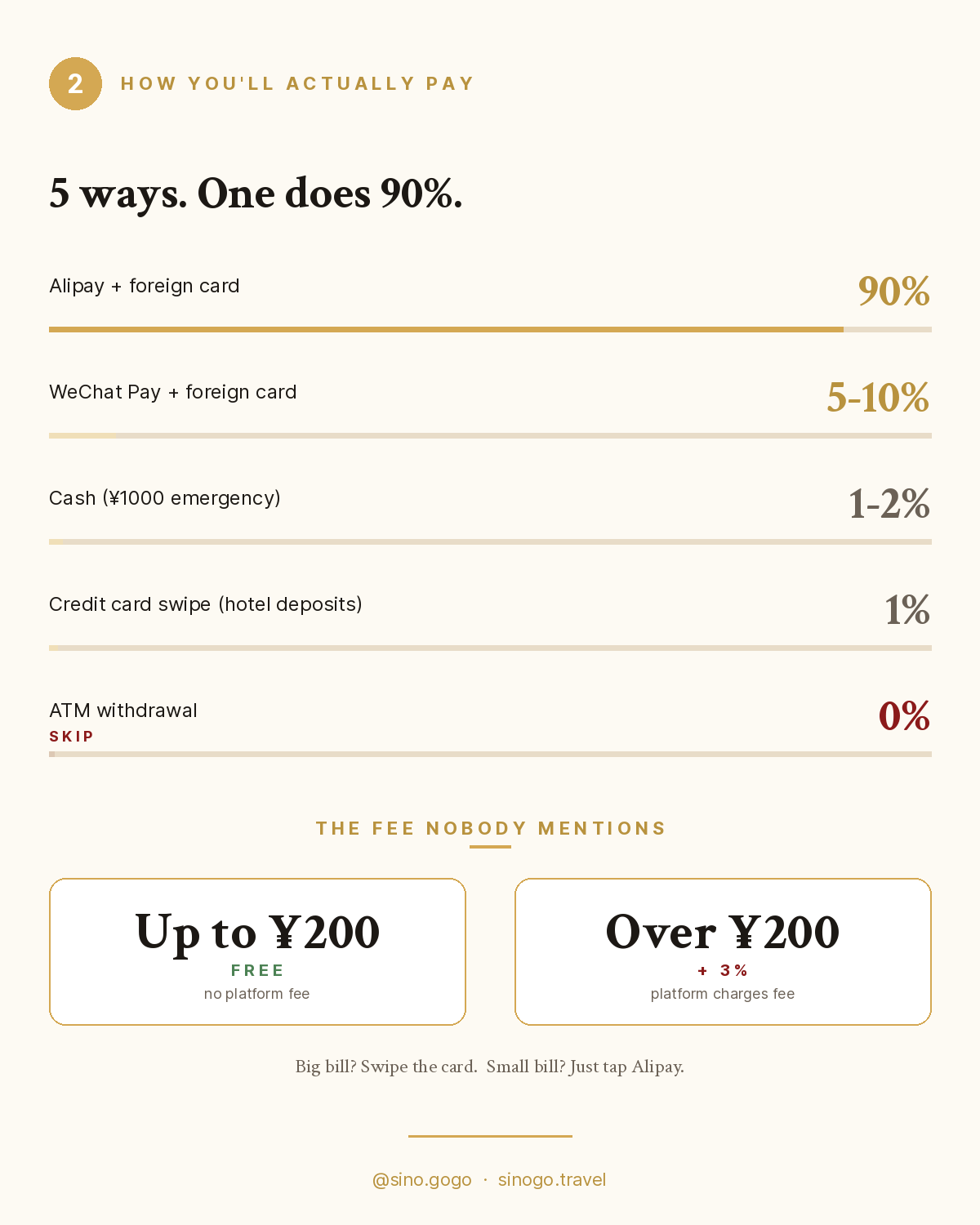
- Alipay + foreign card → 90% of all payments
- WeChat Pay + foreign card → 5-10% (restaurants with WeChat-only mini-program ordering)
- Cash → 1-2% (Day 1 setup, small touristy snack stalls)
- Credit card direct swipe → 1% (hotel deposits)
- ATM withdrawal → 0% (you don't need this)
Since April 2024, foreign cards (Visa/Mastercard/Amex) work seamlessly inside Alipay and WeChat Pay. Most pre-2024 guides are now wrong.
The ¥200 rule (the fee nobody tells you about)
When a foreign card is linked to Alipay or WeChat Pay:
- Single transaction ≤ ¥200: free, no platform fee
- Single transaction > ¥200: Alipay/WeChat charges 3% on top
This is separate from your bank's foreign transaction fee. They stack.
For day-to-day spending (street food, taxis, metro, small meals) — almost everything is under ¥200, so you pay nothing extra. But for hotel bills, fine dining, or big shopping, the 3% adds up.
Three options for big purchases:
- Pay through Alipay anyway — convenient, costs 3%
- Swipe the physical credit card — usually no platform fee from the merchant, but check your card's foreign fee
- Split into multiple <¥200 payments — clunky, hotel won't allow it for the deposit, but works at some merchants
🐷 Bao tip: For a single ¥3000 dinner bill, that's an extra ¥90. Worth swiping the card if it's available. For a ¥30 noodle bowl — just use Alipay.
Setup before you fly (30 min)
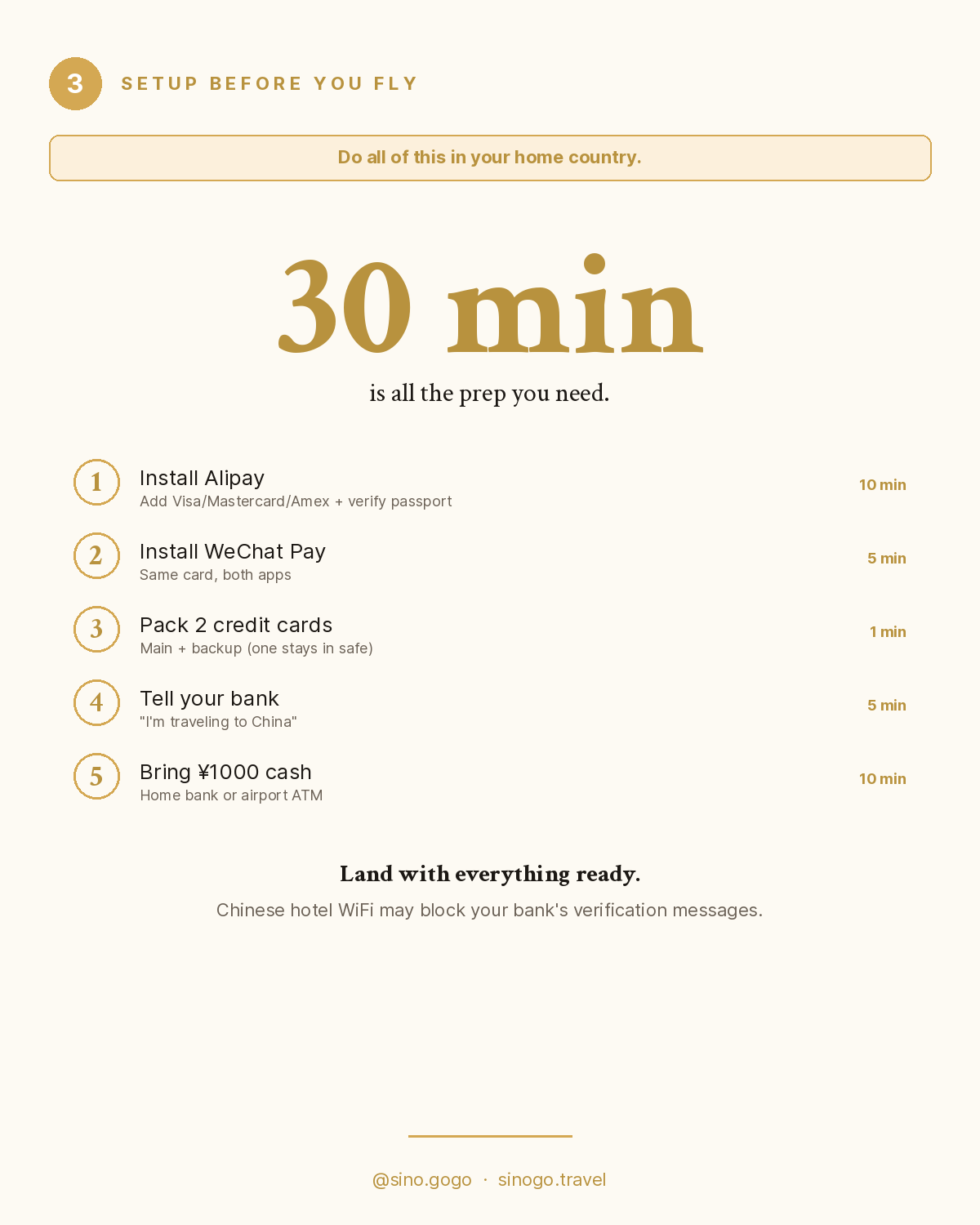
⚠️ Critical: do all of this in your home country. Once you land in China, hotel WiFi runs through the firewall — you may not receive your bank's verification SMS/email needed to activate Alipay or WeChat Pay. Land with everything ready.
✅ 1. Alipay — Download. Add Visa/Mastercard/Amex. Upload passport for ID verification. Set 6-digit password. (Full walkthrough: [Article 1] or [Ep2 Reels].)
✅ 2. WeChat Pay — Same process. Same card.
✅ 3. Pack 2 credit cards — One main (no foreign-fee card), one backup. Backup stays in your hotel safe. Bring physical cards, not just digital wallets.
✅ 4. Tell your bank — "I'm traveling to China." Otherwise your bank may freeze your card on first use.
✅ 5. Bring ¥1000 cash — From your home bank, or pick up at the airport ATM after landing.
🐷 Bao tip: Passport ID verification on Alipay can take a few hours to a few days. Don't leave this for the airplane Wi-Fi or the hotel.
Why ¥1000 cash (~$140 USD)
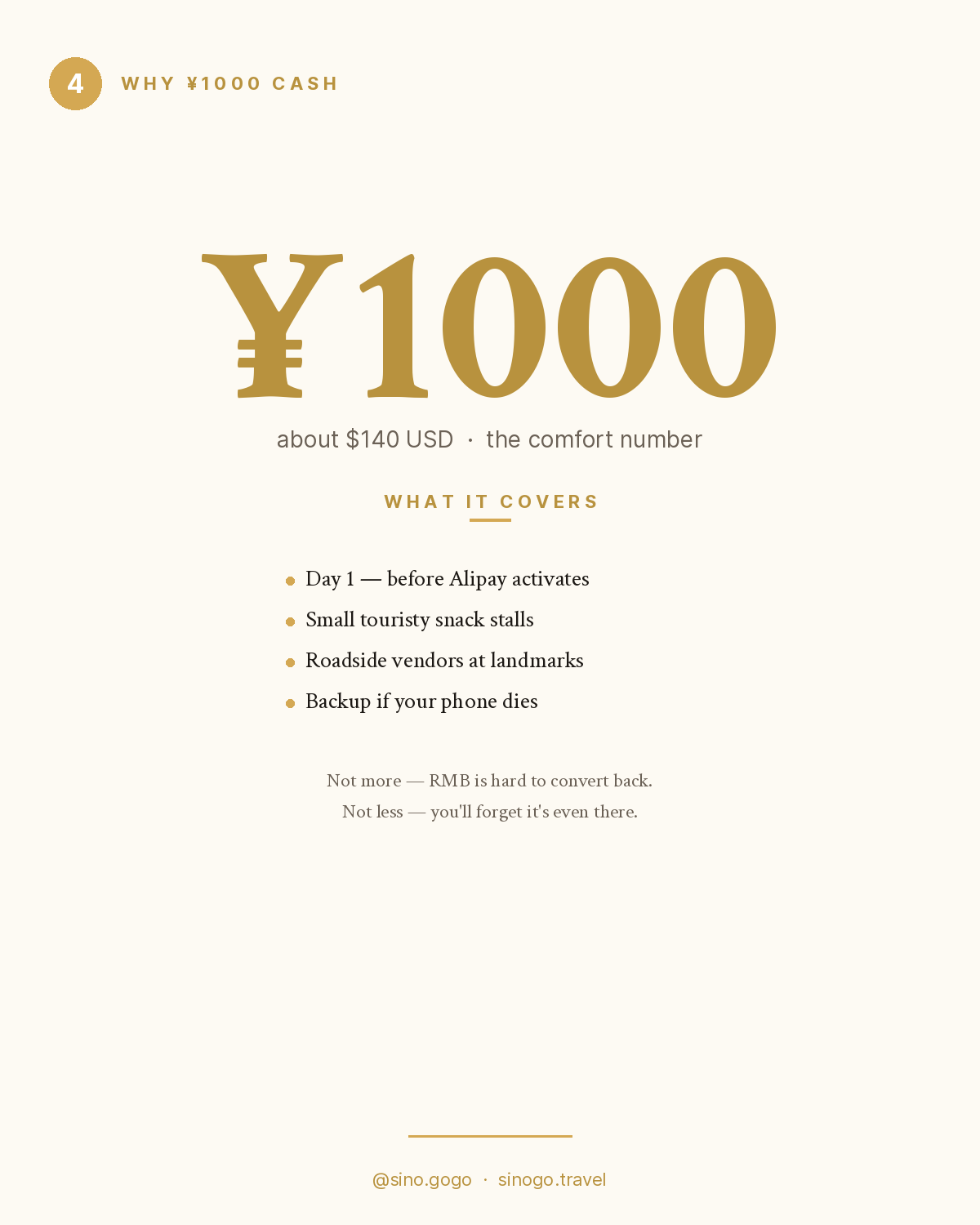
It covers two real situations:
Day 1, before everything's set up. Your phone's still on roaming, Alipay sometimes glitches on first use, and you might land at 11pm when no one's around to help. Cash gets you from airport to hotel without stress.
Small touristy spots. Roadside snack stalls outside the Forbidden City, vendors at markets, that one shop at the Great Wall — small operators sometimes prefer cash for the smallest purchases.
Why not more? RMB is hard to exchange back outside China — you lose 5-8% on the rate. Bring ¥3000 and you'll waste ¥2000 at airport duty-free on your way home.
Why not less? ¥500 is fine if you're confident. ¥1000 is the comfort number — you'll forget it's even in your bag.
🐷 Bao tip: Spend leftover RMB at the airport duty-free on the way out. Best exchange rate you'll ever get.
🐷 Bao tip: China doesn't have tipping culture. Don't tip taxi drivers, hotel staff, or restaurants. High-end restaurants include a service charge in the bill (printed clearly, usually 10-15%) — you don't add anything on top.
Why bring 2 credit cards
Scenario 1: Hotel deposits 4-5 star hotels usually pre-authorize ¥2000-5000 on a credit card at check-in. They release it 1-3 days after checkout. Alipay doesn't replace this — they need a card on file.
Scenario 2: Big purchases above ¥200 When a foreign card is linked to Alipay or WeChat Pay, transactions ¥200 or below are free. Above ¥200, the platform charges 3% (this is on top of any foreign transaction fee your bank charges). For a ¥3000 dinner or shopping bill, swiping the physical card directly may save you the 3% — or just budget for it as the cost of convenience.
Scenario 3: The first 2 hours after landing Until you're on hotel WiFi and Alipay is fully active, having a physical card means you have a backup if anything goes wrong.
Why TWO cards? If your only card is lost, swallowed by a hotel POS machine, or frozen by your bank's fraud detection, you're stranded. Bring a backup — keep it in your hotel safe, not your wallet. One card to use, one card to save your trip.
🐷 Bao tip: Don't bring a debit card "for ATMs" — you don't need ATMs.
WeChat Pay — yes, install it too
Same process as Alipay. Same foreign card works in both apps.
The reason you need both:
Restaurants in China increasingly use mini-program QR ordering. You scan the QR on your table, the menu opens inside an app, you select your dishes and pay there. No paper menu, no waiter taking orders.
The catch: many of these mini-programs run only inside WeChat. If you only have Alipay, you're stuck reading the menu but unable to actually order.
🐷 Bao tip: Don't ask "which one?" before paying. Just scan the QR code in front of you. If it's WeChat, your WeChat Pay opens. If it's Alipay, Alipay opens. Same card, both apps.
🐷 Bao tip: For QR menu ordering, the table sticker usually says "微信扫码" (scan with WeChat) — that's the tell.
Day 1 walkthrough — landing to first Alipay payment
How money actually flows on arrival (assuming you set up everything before flying):
| Time | Action | Payment method |
|---|---|---|
| T+0 | Land, customs, immigration | — |
| T+30 min | Airport ATM if you didn't bring cash | Foreign debit card → ¥500-1000 |
| T+1h | Taxi to hotel | Alipay (DiDi via Alipay works) or cash |
| T+2h | Hotel check-in, deposit | Credit card (¥2000 hold, released 1-3 days after checkout) |
| T+3h | Open Alipay, first payment (water at convenience store) | Alipay |
| Day 2+ | Everything | Alipay (90%) + WeChat Pay (5-10%) |
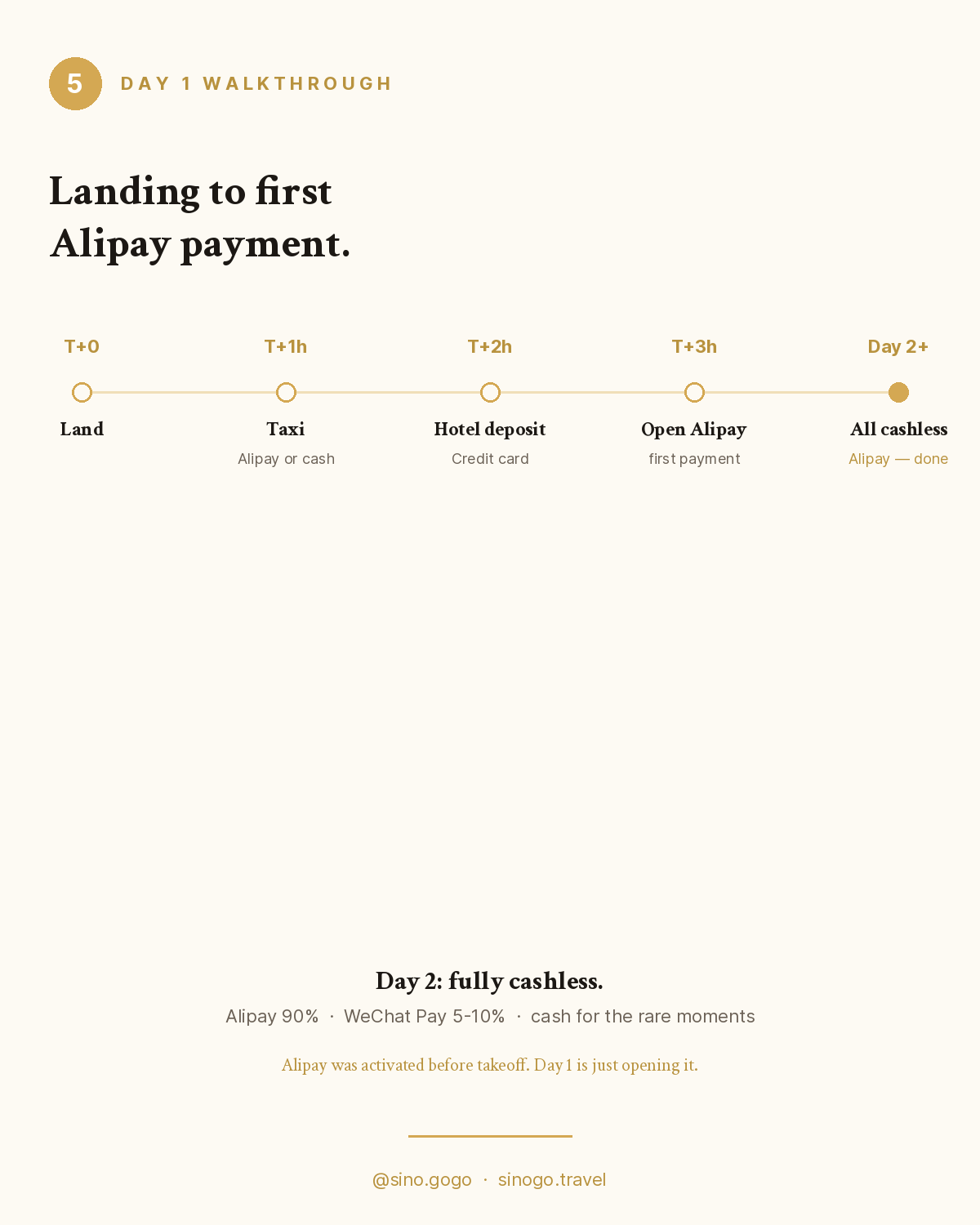
After Day 1, you're fully cashless except for small touristy spots or WeChat-only situations.
Common questions
Q: Will my bank charge foreign transaction fees? Yes, usually 1-3% per Alipay transaction. Use a no-foreign-fee card if you have one.
Q: What if my Alipay payment fails? Switch to WeChat Pay. If both fail, use cash. Rare.
The honest version
Bring: Alipay + WeChat Pay + ¥1000 cash + 2 credit cards.
Skip: $2000 USD, 5+ cards, ATM trips, currency exchange counters, tipping anyone.
Set up everything before you fly — Chinese hotel WiFi runs through the firewall and may block your bank's verification messages.
Tested across Shanghai, Beijing, and Chengdu. Works the same in every Chinese city in 2026.
🐷 Bao approves.
Updated April 2026. For Alipay setup walkthrough, see Article 1. For getting around China without losing your mind, see Article 4.